
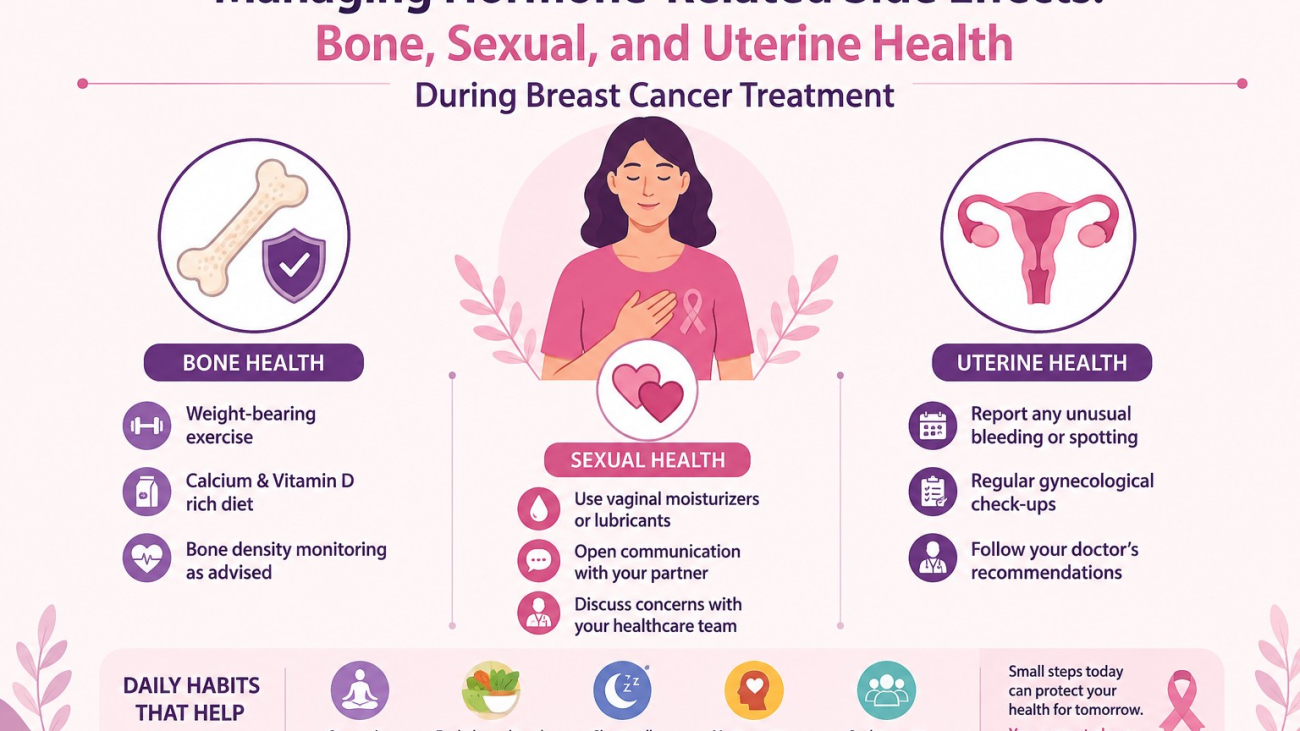
If your cancer care team has put you on hormone therapy, tamoxifen, letrozole, anastrozole, or exemestane, you’ve probably already been told it’s one of the most powerful tools to keep breast cancer from coming back.
What is often not explained as clearly is why this hormone treatment can leave you dealing with brittle bones, dryness and discomfort, or sudden hot flashes in the middle of a cold night.
The answer is simple: these drugs work by lowering or blocking oestrogen, and oestrogen is not just about periods or fertility. It protects your bones, keeps your vaginal and uterine tissue healthy, and quietly influences your mood and sleep too. So when oestrogen drops, your body feels it in more places than you might expect, and since many women stay on this treatment for 5 to 10 years, these aren’t side effects to just push through in silence.
The good news: every one of these effects is well understood, common, and manageable. Here is what to expect, and what actually helps. These side effects are common, manageable, and not something you have to just tolerate quietly. Here is what to expect and what can help.
Why This Looks Different Depending on Your Cancer Type
Not everyone experiences these side effects for the same reason, and it is worth understanding this up front.
If your cancer is hormone receptor-positive (ER+/PR+), it grows in response to oestrogen, so hormone therapy is central to your treatment, and these side effects come directly from that therapy blocking oestrogen.
If you have triple negative breast cancer (TNBC), your tumour does not have oestrogen, progesterone, or HER2 receptors, so hormone therapy does not work on the cancer and is not part of your treatment plan.
But you can still get the same symptoms- bone loss, vaginal dryness, menopause-like changes- through a different route: chemotherapy (especially drugs like cyclophosphamide) can damage the ovaries directly, sometimes causing a sudden, more abrupt menopause.
Some women with BRCA1-linked TNBC also choose to have their ovaries removed as a preventive step, which causes immediate menopause. Either way, the symptoms and support below still apply to you, even if you’re not on tamoxifen or an aromatase inhibitor.
Bone Health
Why it happens
Oestrogen helps keep bones strong. Aromatase inhibitors block oestrogen almost completely, which speeds up bone thinning and raises the risk of osteopenia, osteoporosis, and fractures.
Tamoxifen is different; it can actually protect bone in women past menopause, though it may weaken bone in women still premenopausal. In TNBC, the mechanism is the same underlying loss of ovarian oestrogen, just triggered by chemotherapy or surgery instead of a drug, and the monitoring is identical either way.
What your care team will likely do
- A baseline bone density scan (DEXA scan) before or soon after starting an aromatase inhibitor, repeated every 1 to 2 years
- Blood tests to check vitamin D levels, since deficiency is very common in India even in sunny cities
- Calcium and vitamin D supplements if levels are low
- Bone-strengthening medicines like bisphosphonates (zoledronic acid, alendronate) or denosumab if bone density drops significantly
What you can do
- Weight-bearing exercise: brisk walking, climbing stairs, light resistance training, 3 to 4 times a week
- Calcium-rich foods: dairy, ragi, sesame seeds (til), green leafy vegetables like spinach and drumstick leaves
- Avoid smoking and limit alcohol; both weaken bone further
- Ask about fall-proofing your home if bone density is already low: uneven floors, loose rugs, poor lighting
Sexual Health
Why it happens
Low oestrogen thins and dries the vaginal lining, causing dryness, itching, burning, or pain during sex. This is one of the most common side effects of hormone therapy but also one of the least discussed; many women in India feel hesitant to bring it up even with their doctor. Left unaddressed, it can affect intimacy, confidence, and quality of life for years. TNBC patients going through chemotherapy-induced or surgical menopause experience this just as much, even without being on hormone therapy.
What can help
- Vaginal moisturisers, used regularly, not just before sex, to maintain daily comfort
- Water-based or silicone-based lubricants during intercourse
- Low-dose vaginal oestrogen (cream, ring, or tablet) in some cases; always confirm with your oncologist first, since even local, low-dose oestrogen needs individual clearance. For TNBC patients not on hormone therapy, this is often more straightforward to consider, but BRCA status and other factors still need to be checked
- Non-hormonal prescription options if vaginal oestrogen is not suitable
- Pelvic floor physiotherapy if there is pain or tightness during sex
- Open conversation with your partner about what feels comfortable, timing, and pace can reduce pressure and pain
A note on desire and body image
Reduced libido is common and can come from a mix of hormonal changes, fatigue, surgery (like mastectomy or lymph node removal), and the emotional weight of a cancer diagnosis. This is a valid medical and emotional issue, not something to push through silently. Counselling, sex therapy where available, and honest conversations with your care team can help.
Menopause and Menopause-Like Symptoms
Why it happens
Hormone therapy can trigger menopause in premenopausal women, or worsen symptoms in women already menopausal. In TNBC, chemotherapy or ovary removal can bring on menopause more suddenly and intensely than the gradual oestrogen decline from hormone therapy, since there is no gradual transition. It’s worth knowing this in advance so it doesn’t catch you off guard.
Common symptoms
- Hot flashes and night sweats
- Sleep disturbance
- Mood changes, irritability, low mood
- Vaginal dryness (covered above)
- Joint stiffness or aches, especially with aromatase inhibitors
- Brain fog or trouble concentrating
What can help
- Layered, breathable cotton clothing and keeping a small handheld fan or cooling cloth handy, especially useful in India’s heat and humidity
- Avoiding common triggers for hot flashes: spicy food, caffeine, hot tea, alcohol
- Regular exercise and yoga, shown in several studies to reduce both hot flashes and joint pain
- Cognitive behavioural therapy (CBT), shown to meaningfully reduce hot flash severity and improve sleep
- Certain non-hormonal medicines (low-dose antidepressants or gabapentin) can be prescribed specifically to reduce hot flashes; ask your oncologist if this is an option
- Hormone replacement therapy (HRT) is generally not recommended for hormone receptor-positive breast cancer, so symptom management leans on non-hormonal approaches
- For joint pain, gentle stretching, warm compresses, and sometimes switching between aromatase inhibitors (letrozole to anastrozole, for example) can help, since side effects vary between drugs even within the same class
Uterine Health
This deserves its own attention because the effects differ sharply depending on which drug you’re on, and it’s one of the more important things to monitor.
Tamoxifen and the uterus
Tamoxifen behaves differently in different tissues. In breast tissue it blocks oestrogen, but in the uterus it acts more like a weak oestrogen. Over time, this can cause endometrial thickening, polyps, or hyperplasia (overgrowth of the uterine lining), and a small but real increased risk of endometrial cancer, particularly with long-term use of 5 years or more and in postmenopausal women.
How big is the risk? The absolute increase is small; most studies put it at roughly 2 to 4 times the general population’s risk, but that baseline risk is itself low. The benefit of tamoxifen in reducing recurrence and death almost always outweighs this risk for women who need hormone therapy. This is a monitor-and-manage situation, not a reason to avoid or stop tamoxifen.
Aromatase inhibitors
These work differently, blocking oestrogen production throughout the body rather than acting as a weak oestrogen locally. So they don’t carry the same risk of endometrial stimulation. If anything, low oestrogen can thin the endometrium, in line with the vaginal dryness pattern rather than thickening or cancer risk.
In TNBC
Since TNBC patients aren’t on tamoxifen or aromatase inhibitors, they don’t carry the tamoxifen-specific endometrial cancer risk. But chemotherapy-induced menopause still lowers oestrogen and can thin the endometrium over time, contributing to irregular or absent periods. Some women with BRCA1-associated TNBC discuss uterus-related surgical planning as part of risk-reducing decisions, though this is a separate, individualised conversation with a gynecologic oncologist, not a routine step.
What monitoring looks like
- Routine annual gynaecological check-ups are recommended for all women on tamoxifen.
- Routine ultrasound screening without symptoms is generally not recommended, since endometrial thickening on ultrasound is common with tamoxifen and often not meaningful on its own; over-screening can lead to unnecessary anxiety and procedures.
- The real trigger for further testing is any abnormal bleeding, spotting, or discharge; report this promptly regardless of when your last period was or whether you’re postmenopausal.
- If abnormal bleeding occurs, doctors typically follow up with a transvaginal ultrasound and sometimes an endometrial biopsy or hysteroscopy.
What to watch for and report, regardless of drug or cancer type
- Any vaginal bleeding or spotting after menopause has been established
- Unusually heavy, prolonged, or irregular bleeding while still menstruating
- Unusual vaginal discharge, especially watery or blood-tinged
- Pelvic pain or pressure that is new or persistent
A Few Things Worth Remembering
- These side effects are a sign the treatment is working, not a separate problem to be ashamed of
- You do not have to wait for your next scheduled visit to bring these up, they are valid reasons to call your care team sooner
- Many women stop hormone therapy early because of unmanaged side effects, but most symptoms can be reduced with the right support, so raising them early can help you stay on treatment for the full recommended course
- If one approach does not work, there are usually others to try, this is rarely a one-size-fits-all situation
Don’t give up
Hormone therapy is doing exactly what it’s meant to do, protecting you from recurrence, but that doesn’t mean you have to just live with the side effects quietly. Bone thinning, vaginal dryness, hot flashes, and uterine changes are all known, expected, and treatable parts of this journey, not signs that something has gone wrong or that you’re overreacting. Bring them up with your care team as soon as they start, not at your next scheduled visit. Small adjustments- a supplement, a different moisturiser, a change in drug, a referral to physiotherapy or counselling- can make a real difference in how the next 5 to 10 years actually feel. You don’t have to choose between staying on treatment and feeling like yourself.