
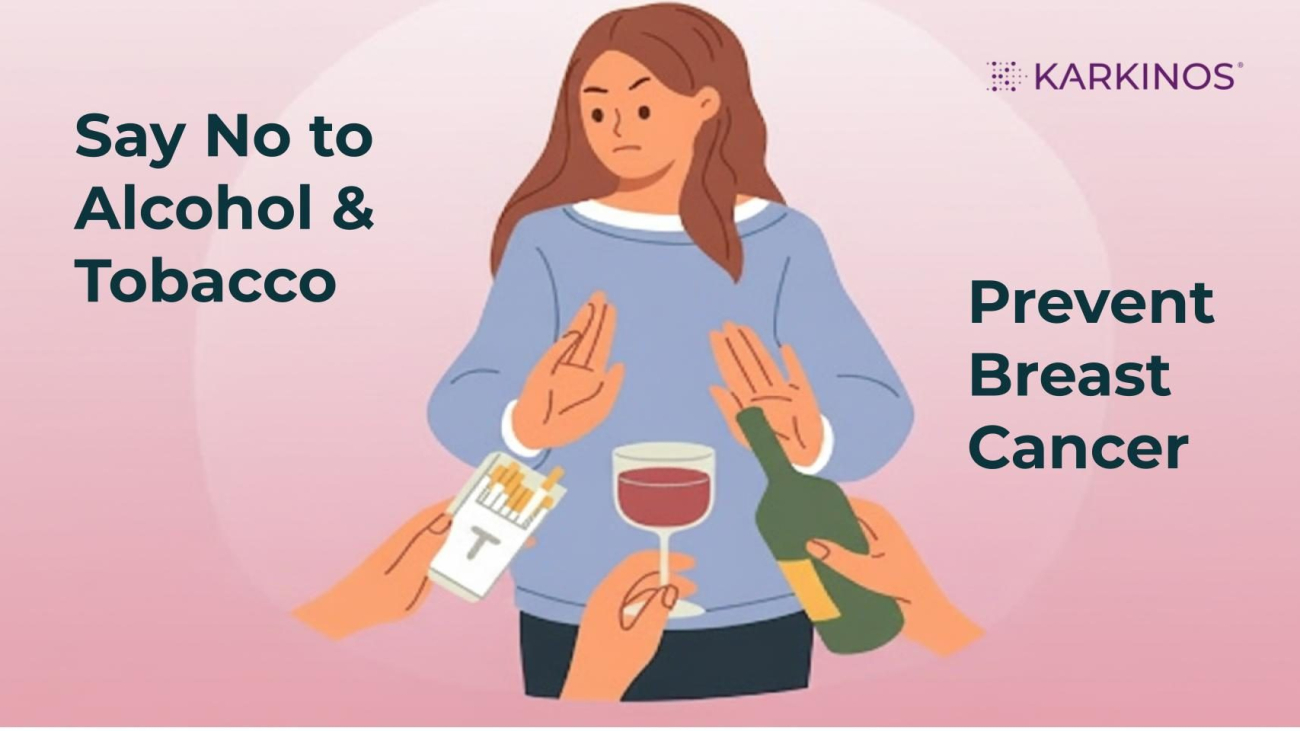
Breast cancer is a growing health concern globally, and in India, it has become the most common cancer among women, surpassing cervical cancer. While genetic and lifestyle factors contribute to this risk, the increasing adoption of certain habits, particularly the consumption of alcohol and smoking any form of tobacco, is adding a layer of danger.
In recent years, the modernisation and westernisation of urban societies in India have led to an increase in smoking and drinking among young women. This trend is often driven by social pressure, workplace stress, or the desire to fit in. However, many do not realise that these habits come with a hidden cost: a significantly higher risk of breast cancer.
This awareness blog examines the critical links between these substances and heightened breast cancer risk, with a focus on the concerning social and psychological factors driving these trends among young Indian women.
Alcohol and Breast Cancer Risk
Alcohol is classified as a known carcinogen. For Indian women, whose bodies may process alcohol differently due to genetic factors, the risk can be particularly significant.
Studies prove that alcohol increases the risk of breast cancer in women through two main mechanisms. First, the liver processes alcohol into acetaldehyde, a toxic compound that can directly damage DNA in breast cells. Second, and particularly significant for women, alcohol consumption elevates blood oestrogen levels, which is a hormonal mechanism contributing to cancer risk.
Alcohol also generates reactive oxygen species, which can contribute to oxidative stress in the cells. Even moderate consumption—defined as one drink a day—has been shown to increase risk, and the danger escalates with the amount consumed. Given that breast cancer is a major health crisis, understanding this direct correlation is vital for prevention.
Young Indian women who are premenopausal should be particularly aware: their bodies are already navigating natural hormonal fluctuations, and alcohol intake adds another layer of oestrogen imbalance.
What Tobacco Does to Breast Tissue
Cigarette smoke contains more than 70 known carcinogens — cancer-causing chemicals that travel through your bloodstream and reach breast tissue.
Research suggests that women who begin smoking in their teens or early twenties face the greatest risk, as breast tissue is still developing during those years and is especially vulnerable to DNA damage.
Nicotine as a Carcinogen: Nicotine, a primary component found in tobacco, has been identified as a significant factor contributing to cancer risk. While it is primarily known for its addictive properties, it is also implicated in cancer progression. Research indicates that nicotine can promote the growth of cancer cells and facilitate tumour development.
Additionally, it may support the formation of blood vessels (angiogenesis) that tumours need to grow and spread. This means that even for those who smoke low-nicotine cigarettes or use nicotine replacement therapies, the substance can still pose a risk beyond mere addiction, affecting overall health and increasing the likelihood of diseases, including breast cancer. The presence of nicotine amplifies the dangers associated with tobacco use and reinforces the need for awareness and cessation efforts among women at risk.
Tobacco also disrupts the body’s ability to repair damaged cells, which is a process critical for preventing abnormal cells from multiplying into tumours. Long-term smokers show higher levels of genetic mutations in breast tissue compared to non-smokers.
Passive smoking is not safe either. Women regularly exposed to second-hand smoke, at home or at work, also face an elevated risk. This is worth remembering in social and professional settings (corporate culture) where smoking is common.
When Both Habits Combine
Many young professionals who drink also smoke, especially in social contexts. Research indicates that the combined effect of both habits is greater than either alone. Alcohol and tobacco appear to interact in ways that further amplify DNA damage in breast cells, compounding the risk beyond what each habit contributes individually.
|
Key Facts at a Glance 🔴 Even 1 alcoholic drink per day raises breast cancer risk by up to 10%. 🔴 Smoking before age 25 is especially harmful — breast tissue is still maturing. 🔴 Passive/second-hand smoke also poses a real risk. 🔴 Combining alcohol and smoking multiplies the damage. 🟢 Quitting or reducing these habits at any age lowers your risk. |
Overcome depression, prevent succumbing to bad habits from social pressure
For many working women in Indian cities today, drinking is no longer purely a personal choice; it is woven into professional life. Office parties, team outings, client dinners, and after-work gatherings carry an unspoken expectation to participate.
Saying no can feel socially costly, even career-limiting. This is a new and underappreciated pressure, and it is placing women in repeated, cumulative exposure to alcohol in ways that feel unavoidable.
Running alongside this is a quieter crisis: depression. Research consistently shows that women are twice as likely as men to experience depression, and Indian women in professional environments face compounded stressors, workload, gender bias, caregiving responsibilities at home, and limited spaces to express distress. When these pressures go unaddressed, alcohol can become a coping mechanism, a way to dull the weight of the day.
Studies on stress, mood disorders, and alcohol use in women show that, unlike men, who more commonly drink to amplify positive feelings, women are significantly more likely to drink in response to negative emotions, loneliness, or low mood.
Depression, in particular, is associated with a markedly elevated risk of alcohol use disorder. This means that for a woman who is already struggling emotionally, social drinking can quietly shift into something harder to control.
The link back to breast health is direct: more frequent drinking, even at moderate levels, steadily raises oestrogen and increases cancer risk. A woman who drinks at work events several evenings a week and also drinks alone to manage stress or sadness may unknowingly be accumulating significant risk over time, a risk that feels invisible because it is embedded in ordinary life.
Recognising this pattern and speaking openly about it with a doctor or counsellor is not a sign of weakness. It is one of the most protective things a woman can do for her long-term health and, most importantly, prevent cancers of the breast, lung, or oral cavity.
|
As of 2025, it was projected that the incidence of breast cancer in Indian women rose to approximately 30.1 cases per 100,000 women*. This increase reflects the growing health crisis and highlights the need for enhanced awareness and preventive strategies. *Reference: Indian Council of Medical Research (ICMR), National Cancer Registry Programme. (2025). “Cancer in India 2025: Current and Projected Incidence. |
A Call to Action
India’s breast cancer incidence is rising, particularly among urban women under 40. While genetics play a role, lifestyle factors are within our control. You do not need to make dramatic changes overnight — even reducing alcohol intake, quitting smoking, and scheduling regular breast self-examinations are meaningful steps.
Talk to your doctor about your personal risk factors. If you smoke or drink regularly, be honest — there is no judgment, only the opportunity to make better-informed choices. Early detection and lifestyle awareness together remain the most powerful tools available to Indian women today.
References
- Romieu I, et al. (2021). Trajectories of alcohol consumption during life and the risk of developing breast cancer. British Journal of Cancer, 125, 1338–1348. https://doi.org/10.1038/s41416-021-01492-w
- Kabat GC, et al. (2014). Alcohol consumption and breast cancer risk by estrogen receptor status: in a pooled analysis of 20 studies. International Journal of Epidemiology, 44(3), 916–925. PMC5005939
- Singletary KW & Gapstur SM. (2001). Alcohol and breast cancer: review of epidemiologic and experimental evidence and potential mechanisms. JAMA, 286(17), 2143–2151. PMC3318874
- Liu Y, et al. (2023). Dose-response relationships between cigarette smoking and breast cancer risk: a systematic review and meta-analysis. JNCI Cancer Spectrum, 7(3). PubMed ID: 36967121
- Xue F, et al. (2011). Cigarette smoking and the incidence of breast cancer. JAMA Internal Medicine (Archives of Internal Medicine), 171(2), 125–133. https://doi.org/10.1001/archinternmed.2010.503
- Wang Y, et al. (2022). The relationship between tobacco and breast cancer incidence: a systematic review and meta-analysis of observational studies. Frontiers in Oncology, 12, 961970. https://doi.org/10.3389/fonc.2022.961970
- Hamajima N, et al. (2002). Alcohol, tobacco and breast cancer: collaborative reanalysis of individual data from 53 epidemiological studies, including 58,515 women with breast cancer and 95,067 without. British Journal of Cancer, 87(11), 1234–1245.
- Subramaniam M, et al. (2013). Professional stress, depression and alcohol use among Indian IT professionals. Indian Journal of Psychological Medicine, 35(1), 39–43. PMC3574458
- Blumenthal H, et al. (2020). The role of stress, trauma, and negative affect in alcohol misuse and alcohol use disorder in women. Alcohol Research: Current Reviews, 40(2). PMC7431322
- Varghese M, et al. (2023). A comprehensive analysis of mental health problems in India. PMC10460242.
Karkinos Healthcare