
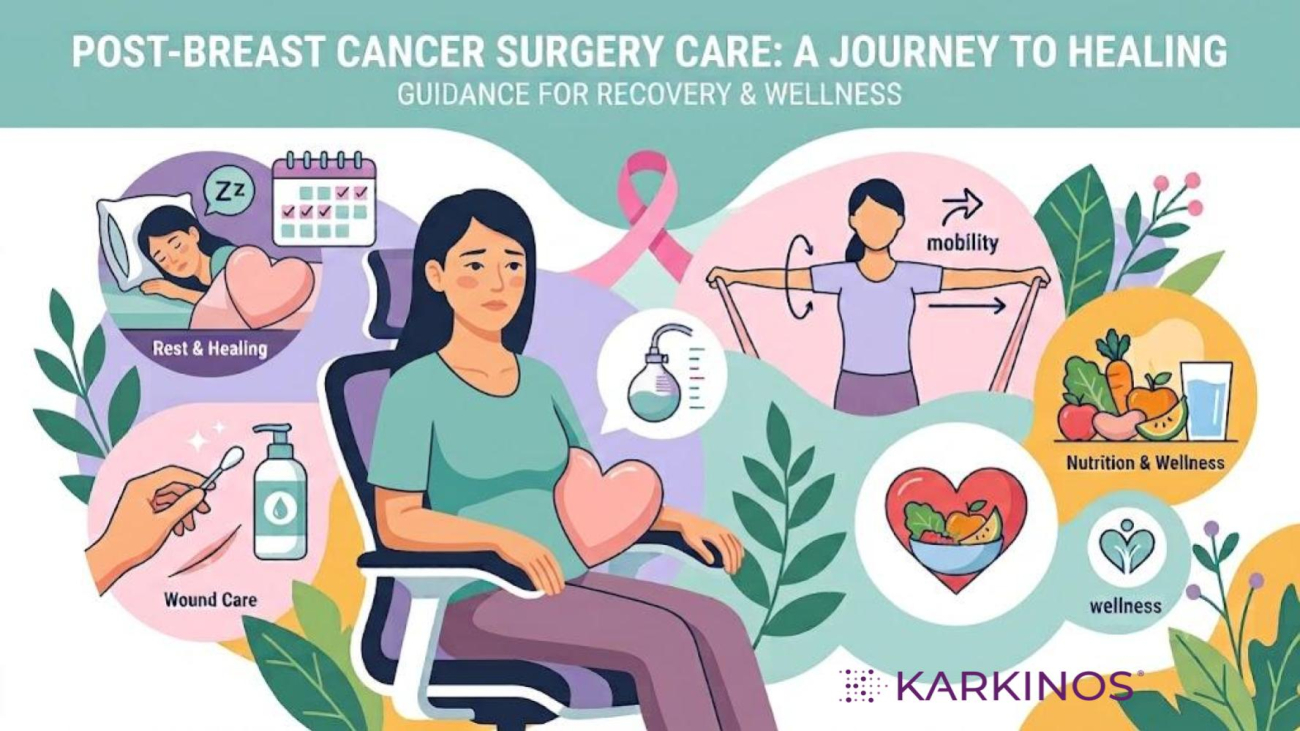
Waking up from breast cancer surgery brings a profound sense of relief, but it also marks the beginning of a whole new phase. Suddenly, the frantic rush of pre-op scans and appointments stops, and you are faced with a quiet recovery room, surgical drains, and a flurry of questions about what comes next.
True recovery isn’t just about letting the incision (surgical site) heal. It is a four-part process that involves physical care, targeted nutrition, emotional grounding, and strategic medical planning.
This is your comprehensive, 360-degree guide to navigating the days and weeks after breast cancer surgery. This guide is meant for both patients and the dedicated family members as caregivers (attenders).
Steps for cautious post-op care
The days and weeks following breast cancer surgery are a critical time for healing. Whether you have had a lumpectomy (removing the tumour) or a mastectomy (removing the whole breast), your body needs time, care, and protection to recover safely.
Here are the most important precautions to take, from the moment you wake up in the hospital through your first few weeks of recovery at home.
At the Hospital – The First 24 to 48 Hours
While you are in the hospital, a team of nurses and doctors will monitor you closely. As a patient, it is very important for you to communicate how you are feeling. Any indication of pain or discomfort must be communicated and must follow the medical team’s guidance for a speedy recovery. Here are some important instructions:
- Protect the incision: Avoid touching the bandages or the surgical site. The nurses will check it regularly to ensure there is no excessive bleeding.
- Stay ahead of the pain: Do not wait for the pain to become severe before asking for medication. It is much easier to keep pain under control if you take medication at the first sign of discomfort.
- Move safely: The nurses will likely encourage you to get out of bed and take short walks the same day or the day after surgery. This is crucial for preventing blood clots in the legs. Always ask a nurse for help the first few times you stand up, as pain medications can make you dizzy.
- Do your breathing exercises: Because your chest feels tight and sore, you might naturally take shallow breaths. The hospital may give you a small plastic device (a spirometer) to help you take deep breaths. This is vital for keeping your lungs clear and preventing pneumonia.
- Learn drain care: If you have surgical drains (small tubes that collect fluid from the surgical site), the nurses will teach you or your caregiver/attender how to empty them and record the amounts of fluid before you go home.
After Discharge – Recovering at Home
Once you are home, the responsibility for daily care shifts to you and your support system. Strict hygiene and careful movement are your top priorities.
Caring for Your Incision and Drains
- Keep it dry: You will likely be told not to shower until your drains are removed or your doctor gives you clearance (usually a few days to a week). Stick to sponge baths until then, being careful to avoid the surgical area.
- Empty drains on a schedule: Empty your drains 2 to 3 times a day as instructed by your nurse. Always wash your hands thoroughly with soap and warm water before and after touching your drains or bandages.
- Secure the drains: Pin the drain bulbs to your clothing (like a loose button-down shirt) so they do not dangle or accidentally get pulled out if they catch on a door handle or furniture.
Protecting Your Arm and Body
- Observe lifting limits: Do not lift anything heavier than 2 to 4 kilograms with the operated arm. For context, this is roughly the weight of a small 2-kg packet of atta (flour) or a large, filled 2-litre water bottle.
This means you must strictly avoid lifting heavy grocery or sabzi bags, a bucket filled with water or wet clothes, heavy kitchen utensils (like a large, filled pressure cooker or kadhai), and even small children or pets. - Limit arm movement: Do not reach your arms high above your head (like reaching for a top shelf) or make repetitive movements (like vacuuming or rigorous scrubbing) until your surgeon says it is safe.
- Sleep positioning: Sleep on your back or on your unaffected side. Use pillows to prop yourself up and place a pillow under your affected arm to reduce swelling.
Lymphedema Precautions (If lymph nodes were removed)
If the surgeon removed lymph nodes from your underarm, that arm is at a higher risk of developing a type of swelling called lymphedema. To protect this arm for the rest of your life, starting immediately:
- No needles or cuffs: Never allow blood pressure cuffs, blood draws, or IVs to be placed on the affected arm.
- Prevent infections: Even a small scratch can lead to an infection. Wear thick gloves when gardening or washing dishes. Use insect repellent to avoid bug bites, and treat any cuts immediately with soap, water, and antibacterial ointment.
- Avoid tight clothing: Do not wear tight jewellery, watches, or sleeves with tight elastic bands on the affected arm.
General Wellness
- Prevent constipation: Pain medications can severely slow down your digestion. Drink plenty of water, eat high-fibre foods (fruits, vegetables, whole grains), and take a stool softener if your doctor recommends one.
- Wear a supportive, loose bra: Your doctor will likely recommend a specific surgical bra or a soft, wire-free cotton bra that fastens in the front to support the area without rubbing the incision.
Do’s and Don’ts for Caregivers/Attenders: Managing Surgical DrainsWhen a patient is recovering from breast cancer surgery, managing the drains is one of the most vital tasks an attender can take over. Use this quick guide to keep the process safe, hygienic, and entirely pain-free for the patient. The Do’s:
The Don’ts:
|
Red Flags: When to Call the Doctor Immediately
While healing takes time, certain symptoms require immediate medical attention. Call your surgical team or go to the emergency room if you experience:
- A fever of 100.4°F (38°C) or higher.
- Sudden, severe pain that your medication does not help.
- The incision becomes very red, hot to the touch, or starts oozing foul-smelling fluid (signs of infection).
- Sudden swelling in your arm, hand, or chest on the side of the surgery.
- Excessive bleeding that soaks through your bandages.
- Shortness of breath or sudden chest pain (a medical emergency).
Fueling the Body: Post-Op Diet & Nutrition
Surgery puts the body into a high-energy-demanding repair state. To knit tissues back together and recover from anaesthesia, the body needs good nutrition. This is not the time for extreme, restrictive diets.
The Essential Healing Blocks
| Nutrient | Why It Matters | Where to Find It |
| Lean Proteins | The literal building blocks for cellular repair and skin healing. | Chicken, fish, eggs, paneer, tofu, lentils (dals), and sprouts. |
| Vitamins C & Zinc | Critical catalysts for skin remodelling and keeping the immune system sharp. | Lemons, oranges, berries, kiwi, bell peppers, broccoli, and pumpkin seeds. |
| High-Fiber Carbs | To prevent constipation caused by pain medication and lower activity levels, and to provide steady energy. | Whole grains, oats, starchy vegetables and fresh fruits. |
| Hydration | Flushes out residual anaesthesia and maintains optimal cell function. | Water, clear broths, and tender coconut water (aim for 2–3 litres daily). |
A Quick Reality Check on “Cancer Diets”
Well-meaning friends might advise cutting out all sugar, dairy, or carbohydrates to “starve the cancer.” Right now, the body is starved for energy to heal a major surgical wound. Focus on balanced, easily digestible, home-cooked meals. If appetite is low, switch from three large meals to 5 to 6 small, nutrient-dense snacks throughout the day.
Taking Care of Your Mind and Feelings
Surgery is a major life event. While your physical body heals, your mind will also undergo many changes.
Before the surgery, you were likely busy with hospital dates, tests, and packing your bags. Once you are back home and everything goes quiet, the reality of the situation can suddenly set in. It is completely normal to feel a sudden wave of deep sadness, fear, or exhaustion during this time.
Common Mind Hurdles You May Face
- Stress While Waiting for Reports: It takes about 5 to 7 days for the final lab reports to come back. Waiting for these results and for the next treatment step can be the most stressful part of the whole journey.
- Sadness About Body Changes: Looking at your surgery marks for the first time can be very hard. It is normal to feel a sense of loss, sadness, or worry about how your body looks now.
- The Benefit of Talking to a Counsellor: Most hospitals (including Karkinos Healthcare) have dedicated emotional counsellors for cancer patients. Talking to them gives you a safe space to share your deepest fears—fears you might be hiding from your own family because you don’t want to worry them.
Quick Tips for Peace of Mind
The Do’s:
- Do let yourself cry: It is entirely normal to feel angry, sad, or terrified while waiting for your reports. Do not hold back your tears. Crying is a natural way the body releases stress.
- Do limit your visitors: Your recovery room is for resting, not for hosting social gatherings. If you are tired, tell your caregiver to politely ask well-wishers to call or visit later.
The Don’ts:
- Don’t force yourself to smile: Do not feel guilty if you cannot stay “brave” or “positive” 24/7. True strength includes admitting when you are having a bad day.
- Don’t look at your surgery marks alone: The very first time you feel ready to look at your wound or scar, do not do it by yourself. Have a supportive family member, partner, or nurse stand right next to you to hold your hand and give you comfort.
Post-Operative Breast Cancer Care Timeline
| Timeline | What Happens? | What Patients & Caregivers Should Do |
| Day 0 (Surgery Day) | Surgery completed. Patient is monitored in recovery. | Rest, pain control, begin deep breathing exercises, follow nursing instructions. |
| Days 1–3 | Wound assessment, drain care (if present), discharge planning. | Learn drain care, begin gentle arm movements (if advised), eat a protein-rich diet, walk short distances. |
| Week 1 | Healing begins. Dressings may be changed. | Keep the wound clean and dry, avoid lifting heavy objects, watch for fever, redness, swelling, or excessive pain. |
| Week 1–2 | Pathology report becomes available. | Attend follow-up appointment. Discuss tumour size, lymph nodes, margins, ER/PR, HER2 status, and cancer stage. |
| Week 2–3 | Tumour Board reviews the case. | Meet your oncologist to understand whether chemotherapy, radiation, hormone therapy, targeted therapy, or immunotherapy is recommended. |
| Weeks 3–6 | Additional treatment planning. Surgical recovery continues. | Begin physiotherapy if advised, improve shoulder mobility, continue nutritious meals, attend all appointments. |
| 4–8 Weeks | Radiation or chemotherapy may begin (depending on the treatment plan). | Follow the treatment schedule, report side effects early, stay physically active as tolerated, maintain hydration and nutrition. |
| After Chemotherapy (if required) | Radiation or hormone therapy may follow. | Continue prescribed medications, attend rehabilitation sessions, monitor emotional well-being. |
| Long-Term (Months to Years) | Regular surveillance and survivorship care. | Clinical follow-ups, mammograms (when advised), manage lymphoedema risk, maintain a healthy lifestyle, report any new symptoms promptly. |
Mapping the Next Steps: The Tumour Board Review
Surgery is often the first major victory, but it is rarely the last step. To ensure the cancer does not return, the patient’s case is presented again to the Tumour Board—a multidisciplinary panel of medical minds who collaborate to design the next phase of treatment.
Rather than relying on a single doctor’s opinion, the board brings together:
- Surgical Oncologists (who look at how the surgery went)
- Medical Oncologists (systemic drug and chemotherapy experts)
- Radiation Oncologists (local radiation experts)
- Pathologists (who study the tumour cells under a microscope)
These specialists will discuss the next steps based on your unique cancer biology and its most effective treatment options.
The Three Keys They Analyse
The board waits for the final pathology report to look at three vital puzzle pieces:
- The Surgical Margins: Is the tissue surrounding the removed tumour completely clear of cancer cells?
- Lymph Node Status: Did the cancer begin travelling to the lymph nodes under the armpit?
- Tumour Biology (Biomarkers): Is the cancer hormone-driven (ER/PR-positive)? Is it HER2-positive? What is its cellular growth grade?
The Resulting Blueprint
Based on these cellular details, the board will sequence a personalised timeline, usually scheduled to begin 3 to 6 weeks after surgery once the body is physically strong:
- Chemotherapy: Used if there is a risk that microscopic cells entered the bloodstream, destroying them systemically.
- Radiation Therapy: High-energy beams that sweep the local area (standard after a lumpectomy) to minimise local recurrence.
- Hormone (Endocrine) Therapy: Daily pills (like Tamoxifen) taken for 5 to 10 years if the tumour is hormone receptor-positive, starving rogue cells of fuel.
- Targeted/Immunotherapy: Precision drugs designed to block specific proteins like HER2.
Completing breast cancer surgery is a massive milestone, but keeping the cancer away permanently requires a lifelong commitment to regular medical care. Even when you feel completely healthy, attending every single scheduled periodic health examination and routine scan—like mammograms or ultrasounds—is absolutely non-negotiable. These regular hospital visits act as your ultimate safety net, allowing your medical team to spot tiny, hidden changes deep inside the body long before you could ever feel them with your hands, making early detection your most powerful tool.
Alongside doctor visits, you and your caregiver must practice everyday diligence by closely monitoring your body at home. Once your surgical wounds heal, make it a habit to gently check your chest area, underarms, and other breast once a month for any new lumps, skin changes, or unusual arm swelling.
Never hesitate or wait for your next scheduled appointment if something feels off; combining strict medical follow-ups with your own daily alertness is the absolute best blueprint for your long-term safety and peace of mind.
Medical disclaimer: This article is for general educational purposes only and does not constitute medical advice. Guidelines vary by centre, patient profile, and resource availability. Always consult a qualified oncologist or breast cancer specialist for individual guidance.
Karkinos Healthcare