
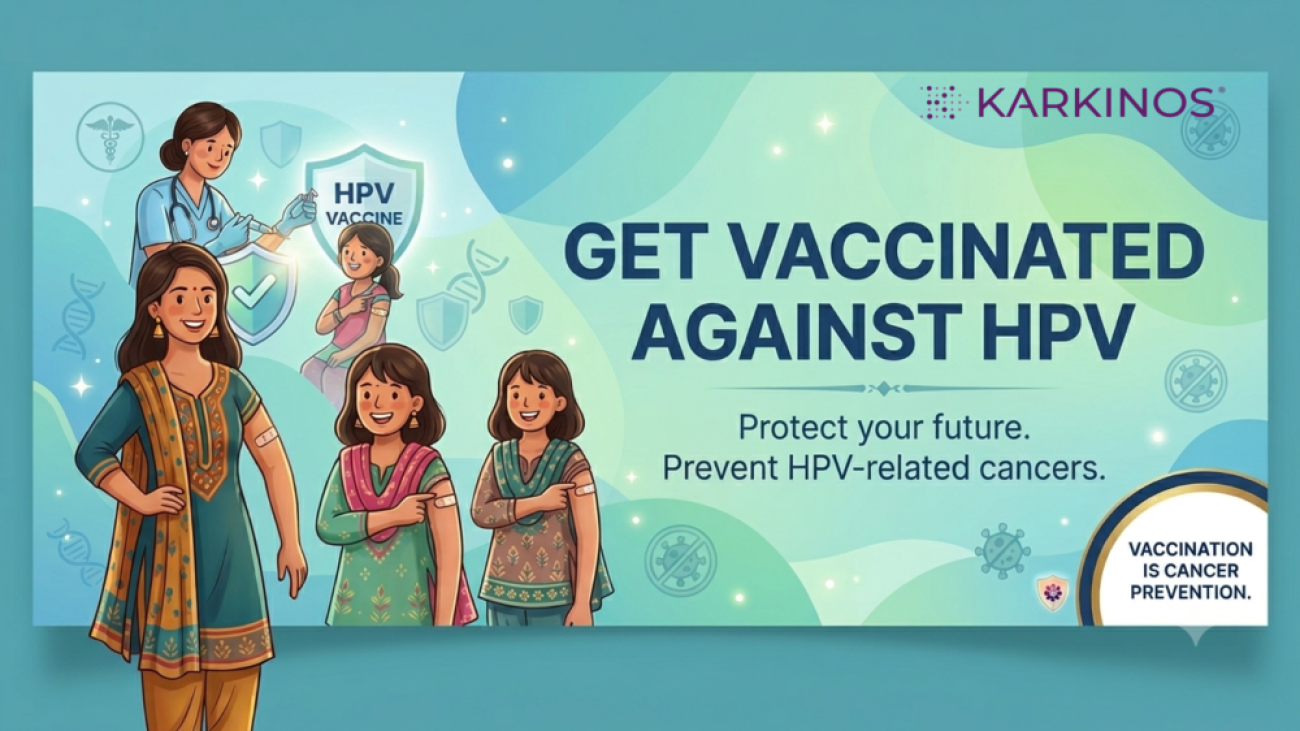
In our previous article on the slow progression of HPV, we looked at how the virus’s gradual timeline gives us a critical window of opportunity to detect and prevent cervical cancer. The Human Papillomavirus (HPV) vaccine is the strongest way to close that door early. Capable of preventing over 90% of HPV-related cancers, immunisation protects against high-risk strains long before silent cellular changes can ever begin.
In India, where cervical cancer is the second most common cancer among women with over 1.2 lakh new cases and nearly 80,000 deaths every year, timely vaccination combined with routine screening is central to eliminating preventable HPV-related cancers.
How the Vaccine Builds Immunity
Unlike traditional vaccines that use a weakened or dead version of a virus, the HPV vaccine contains no real virus or viral DNA at all, meaning it cannot cause an HPV infection or cancer. Instead, it uses harmless, lab-made virus-like particles (VLPs) built from a single protein on the virus’s outer shell.
When injected, these hollow particles mimic the real virus’s shape, training your immune system to produce strong protective antibodies. If your body encounters actual HPV strains later in life, those antibodies recognise the virus and block it from entering and infecting healthy cells.
When injected, these hollow particles mimic the real virus, prompting the immune system to produce high levels of virus-fighting antibodies. If the body encounters actual HPV strains later in life, those antibodies bind to the virus and block it from entering and infecting healthy cells.
Depending on the formulation, HPV vaccines target the most dangerous strains:
- High-Risk Cancer-Causing Strains (Types 16, 18, 31, 33, 45, 52, and 58): Types 16 and 18 alone cause roughly 70% of cervical cancers globally—and over 80% of cervical cancer cases in India—along with the vast majority of anal cancers. Nonavalent vaccines add protection against types 31, 33, 45, 52, and 58, covering another 20% of cervical cancers as well as HPV-related throat (oropharyngeal), vaginal, vulvar, and penile cancers.
- Low-Risk Strains (Types 6 and 11): Responsible for approximately 90% of genital warts and recurrent respiratory papillomatosis.
Who Needs It and Ideal Timing by Age
Timing is the single most important factor in maximising the vaccine’s impact. Health authorities recommend vaccinating in pre-adolescence for two reasons: the vaccine only prevents new infections (it cannot clear existing ones), and younger immune systems produce a significantly stronger antibody response than adult immune systems.
| Age Group / Profile | Recommended Timing | Standard Dosing Schedule | Clinical Notes |
| Preteens & Young Adolescents (Ages 9–14) | Ideal window prior to sexual exposure | 2 doses, given 6 months apart (or 1 dose under India’s national programme and WHO single-dose guidance) | Generates peak antibody response; starting before the 15th birthday requires fewer doses. |
| Teens & Young Adults (Ages 15–26) | Catch-up vaccination for anyone not fully immunized | 3 doses, given at 0, 1–2 months, and 6 months | Recommended for both females and males who missed earlier vaccination. |
| Adults (Ages 27–45) | Licensed for use; based on shared clinical decision-making | 3 doses, given at 0, 1–2 months, and 6 months | Most beneficial for adults entering new sexual relationships who remain unexposed to covered strains. |
| Immunocompromised Individuals (Ages 9–26+) | As soon as eligible within approved age windows | 3 doses, regardless of age at first shot | Includes individuals living with HIV or taking immunosuppressive medications. |
Vaccine Availability, Cost, and Access in India
In India, both public health initiatives and domestic vaccine manufacturing have dramatically expanded access and lowered out-of-pocket costs:
- Free Nationwide Government Vaccination Drive: Launched in February 2026, the Government of India provides free-of-cost HPV vaccination to approximately 1.15 crore girls aged 14 years across all States and Union Territories.
Administered at designated government health centres (including Ayushman Arogya Mandirs, Community Health Centres, and District Hospitals), the programme uses a single-dose regimen of quadrivalent Gardasil-4—which delivers 93% to 100% protection against targeted cancer-causing strains while eliminating follow-up drop-offs. - Affordable Indigenous Vaccine (CERVAVAC): Developed by the Serum Institute of India in collaboration with the Department of Biotechnology, CERVAVAC is India’s first indigenous quadrivalent HPV vaccine and holds WHO prequalification. Priced at roughly ₹1,800 to ₹2,000 per dose in private clinics, it brings the cost of a complete 2-dose childhood series down to around ₹4,000—nearly half the price of imported alternatives.
- Private-Sector Options for Boys, Older Teens, and Adults: Individuals outside the government’s 14-year-old cohort—including boys, young men, and adult women up to age 45—can access HPV vaccines through private hospitals, paediatricians, and gynaecology clinics:
| Vaccine Available in India | Strains Covered | Eligible Age & Gender (India) | Approx. Private Cost per Dose |
| CERVAVAC (Indigenous) | 4 strains (6, 11, 16, 18) | Girls & boys aged 9–26 (CDSCO-approved) | ₹1,800 – ₹2,000 |
| Gardasil 4 (Imported) | 4 strains (6, 11, 16, 18) | Girls/women aged 9–45 & boys/men aged 9–26 (Free at govt. centres for 14-year-old girls) | ₹3,000 – ₹4,000 |
| Gardasil 9 (Imported) | 9 strains (6, 11, 16, 18, 31, 33, 45, 52, 58) | Girls/women aged 9–45 & boys/men aged 9–26 | ₹9,000 – ₹10,850 |
(Note: Cervarix, an imported bivalent vaccine covering types 16 and 18 at ₹2,500–₹4,000 per dose, is also licensed in India, though less commonly stocked than quadrivalent and nine-valent options.)
Adult Eligibility: Who Benefits After Age 26?
Routine catch-up vaccination applies to everyone through age 26. For adults aged 27 through 45, HPV vaccination is licensed and available through shared clinical decision-making—meaning it is not universally recommended for every adult in this bracket, but rather decided through an individualised conversation with a doctor.
Because HPV is widespread, many adults in their late 20s, 30s, and 40s have already been exposed to one or more strains, reducing the population-wide impact of universal adult vaccination. However, adults aged 27 to 45 are strong candidates for the shot if they:
- Are entering a new relationship or expect to have new sexual partners in the future.
- Have had limited prior sexual partners and likely remain unexposed to most high-risk strains.
- Never started or never completed their childhood or young-adult vaccine series.
Conversely, adults in long-term, mutually monogamous relationships generally have a very low risk of acquiring a new HPV infection and typically gain minimal additional benefit.
| Does family history matter, or is cervical cancer hereditary?
Unlike breast or ovarian cancer, cervical cancer is not inherited through your genes. More than 99% of cases are caused by a persistent high-risk HPV infection rather than family history. This means having no family history of cervical cancer does not protect you from HPV—and having a mother or sister who had it does not mean you are destined to develop it. Everyone benefits equally from HPV vaccination and regular screening. |
Common Questions About Getting the Shot
Q: Does the vaccine still work if I am already sexually active?
Yes. Being sexually active—or even having tested positive for one strain of HPV in the past—does not mean you have been exposed to every strain covered by the vaccine. The shot will still protect you against the remaining high- and low-risk strains you have not yet encountered. Doctors do not recommend HPV testing before getting vaccinated.
Q: Will the vaccine clear an existing HPV infection or abnormal Pap smear?
No. The HPV vaccine is strictly preventive. It cannot treat active HPV infections, clear genital warts, or reverse existing precancerous cell changes.
Q: If I get vaccinated, can I skip cervical cancer screenings?
No. Because vaccines protect against the primary cancer-causing strains rather than 100% of all rare oncogenic types, routine cervical cancer screening—via Pap smears or VIA (Visual Inspection with Acetic Acid) at public health clinics, or HPV DNA testing in private centres—remains essential on your doctor’s recommended schedule.
Q: How long does immunity last, and will I need a booster?
Long-term clinical follow-up studies exceeding 12 to 15 years show durable, sustained antibody protection with no evidence of waning immunity over time. Booster doses are not recommended once an age-appropriate schedule is completed.
Q: Who should avoid or delay the HPV vaccine?
The vaccine has an extensive global safety record, with common side effects limited to temporary arm soreness, mild fatigue, headache, or low-grade fever. However, it should not be given to anyone with a severe allergy to yeast (used in manufacturing) or a previous vaccine component. Vaccination is also deferred during pregnancy, though it is safe for eligible adults who are breastfeeding.